

Sahara space rock 4.5 billion years old upends assumptions about the early Solar System
- Written by Evgenii Krestianinov, PhD candidate, Research School of Earth Sciences, Australian National University
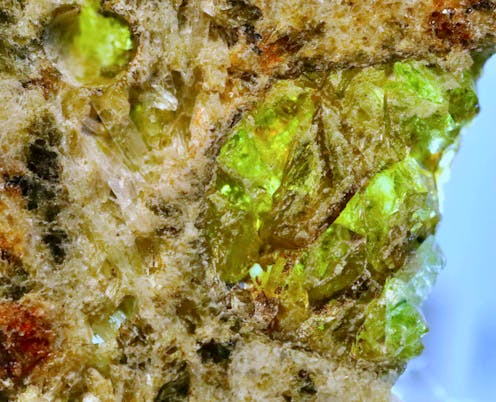
In May 2020, some unusual rocks containing distinctive greenish crystals were found in the Erg Chech sand sea, a dune-filled region of the Sahara Desert in southern Algeria.
On close inspection, the rocks turned out to be from outer space: lumps of rubble billions of years old, left over from the dawn of the Solar System.
They were all pieces of a meteorite known as Erg Chech 002, which is the oldest volcanic rock ever found, having melted long ago in the fires of some now-vanished ancient protoplanet.
In new research published in Nature Communications, we analysed lead and uranium isotopes in Erg Chech 002 and calculated it is some 4.56556 billion years old, give or take 120,000 years. This is one of the most precise ages ever calculated for an object from space – and our results also cast doubt on some common assumptions about the early Solar System.
The secret life of aluminium
Around 4.567 billion years ago, our Solar System formed from a vast cloud of gas and dust. Among the many elements in this cloud was aluminium, which came in two forms.
First is the stable form, aluminium-27. Second is aluminium-26, a radioactive isotope mainly produced by exploding stars, which decays over time into magnesium-26.
Aluminium-26 is very useful stuff for scientists who want to understand how the Solar System formed and developed. Because it decays over time, we can use it to date events – particularly within the first four or five million years of the Solar System’s life.
The decay of aluminium-26 is also important for another reason: we think it was the main source of heat in the early Solar System. This decay influenced the melting of the small, primitive rocks that later clumped together to form the planets.
Uranium, lead and age
However, to use aluminium-26 to understand the past, we need to know whether it was spread around evenly or clumped together more densely in some places than in others.
To figure that out, we will need to calculate the absolute ages of some ancient space rocks more precisely.
Looking at aluminium-26 alone won’t let us do that, because it decays relatively quickly (after around 705,000 years, half of a sample of aluminium-26 will have decayed into magnesium-26). It’s useful for determining the relative ages of different objects, but not their absolute age in years.
But if we combine aluminium-26 data with data about uranium and lead, we can make some headway.
There are two important isotopes of uranium (uranium-235 and uranium-238), which decay into different isotopes of lead (lead-207 and lead-206, respectively).
The uranium isotopes have much longer half-lives (710 million years and 4.47 billion years, respectively), which means we can use them to directly figure out how long ago an event happened.
Meteorite groups
Erg Chech 002 is what is known as an “ungrouped achondrite”.
Achondrites are rocks formed from melted planetesimals, which is what we call solid lumps in the cloud of gas and debris that formed the Solar System. The sources of many achondrites found on Earth have been identified.
Most belong to the so-called Howardite-Eucrite-Diogenite clan, which are believed to have originated from Vesta 4, one of the largest asteroids in the Solar System. Another group of achondrites is called angrites, which all share an unidentified parent body.
Still other achondrites, including Erg Chech 002, are “ungrouped”: their parent bodies and family relationships are unknown.
A clumpy spread of aluminium
In our study of Erg Chech 002, we found it contains a high abundance of lead-206 and lead-207, as well as relatively large amounts of undecayed uranium-238 and uranium-235.
Measuring the ratios of all the lead and uranium isotopes was what helped us to estimate the age of the rock with such unprecedented accuracy.
We also compared our calculated age with previously published aluminium-26 data for Erg Chech 002, as well as data for various other achondrites.
Read more: What are asteroids made of? A sample returned to Earth reveals the Solar System's building blocks
The comparison with a group of achondrites called volcanic angrites was particularly interesting. We found that the parent body of Erg Chech 002 must have formed from material containing three or four times as much aluminium-26 as the source of the angrites’ parent body.
This shows aluminium-26 was indeed distributed quite unevenly throughout the cloud of dust and gas which formed the solar system.
Our results contribute to a better understanding of the Solar System’s earliest developmental stages, and the geological history of burgeoning planets. Further studies of diverse achondrite groups will undoubtedly continue to refine our understanding and enhance our ability to reconstruct the early history of our Solar System.
Authors: Evgenii Krestianinov, PhD candidate, Research School of Earth Sciences, Australian National University

















