Modern Australian
The Times

nurses’ skills are too often wasted in general practice

  • Written by Peter Breadon, Program Director, Health and Aged Care, Grattan Institute

Australians are living longer, but we’re also living longer with disease and disability. Half of us now have at least one chronic condition.

As rates of disease rise, so does demand for health care. In the 40 years since Medicare began, the average number of visits to the GP per person has increased by more than 60%.

Now general practice – where most people go first for check-ups, diagnoses, and ongoing management of chronic conditions – is under pressure. In 2024, nearly 30% of Australians said they waited too long to get the primary care they needed.

But Australia has more nurses per person than many similar countries. Removing barriers that prevent nurses from using all their skills could help meet the growing demand for care.

Nurses’ skills are being wasted

Primary care works best when delivered by a team: with doctors working alongside nurses, pharmacists, allied health professionals and other health workers.

When the team can safely use all their skills and training, patients benefit from improved access, equal or better health outcomes, improved efficiency and potential cost savings.

However GPs in Australia are less likely than those in similar countries to delegate tasks tasks such as immunisations, routine health checks and health promotion to nurses.

Two recent independent reviews found that while many practices employ a nurse, most are not using all their skills.

nurses’ skills are too often wasted in general practice
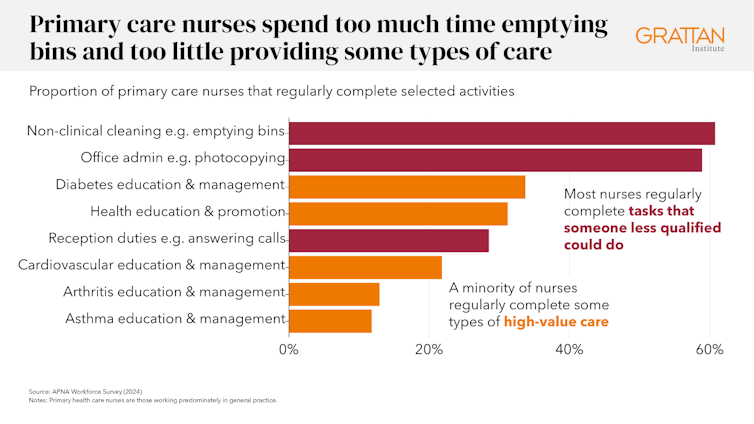
Grattan Institute, CC BY Nurses working in primary care agree. A 2024 workforce survey found only one-third of surveyed nurses in general practice regularly work to their full scope of practice. Nurses are spending too much time doing basic tasks that others could do, taking them away from giving the care they are trained to provide. About 60% of surveyed nurses said they regularly emptied bins or did photocopying. Meanwhile, less than one-third regularly provided health education and promotion services to patients, despite good evidence that doing so is safe and effective. nurses’ skills are too often wasted in general practice
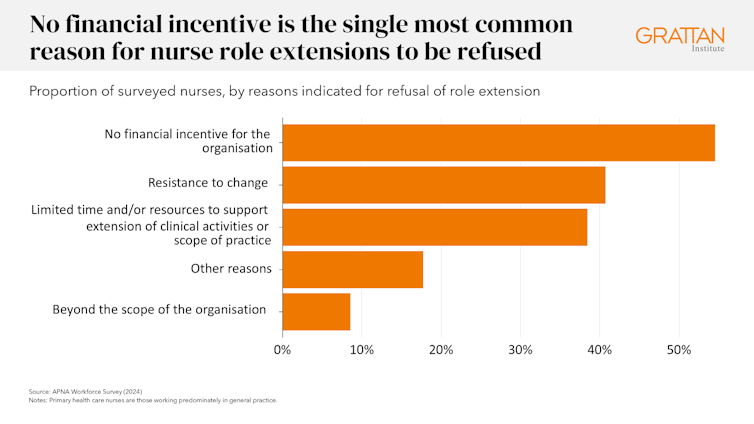
Grattan Institute, CC BY Nurses want to do more. Four in ten said they want to provide health education and promotion services more often. Nearly half (48%) said they had asked to do more complex clinical activities or extend their role in the past year. While there is a long way to go, there has been some progress. The proportion of primary care nurses who said they regularly work to their full scope of practice rose from 29% in 2019 to 35% in 2024. Nurses are being allowed to do more In the past year and a half, reviews commissioned by the federal government have identified three key areas for reform. First, the 2024 Scope of Practice Review found confusion across the sector about what nurses can do, and inconsistent rules between states that make it harder for practices to employ their nursing workforce effectively. It called on federal and state governments to create a national framework that clearly sets out what different health workers can do. Second, governments and accreditation bodies need to change the way health workers are regulated. Regulation should reflect the activities health workers are trained and qualified to perform safely, not rigid professional boundaries. State governments should harmonise their legislation – including drugs and poisons acts – so the rules align with workers’ capabilities and are consistent across jurisdictions. In October, there was a big step forward in expanded and nationally consistent nurse roles. Specially qualified registered nurses will now be able to prescribe medicines. A funding fix is needed too Both the Scope of Practice Review and the 2024 Review of General Practice Incentives found changes like these won’t fully succeed without another change: fixing the way Australia funds primary care. The new rules allowing registered nurse prescribing are one example. Just last week a senate committee unanimously recommended nurse prescriptions should get the same subsidy at the pharmacy as scripts from doctors, instead of costing more as a private script. Medicare funding needs to keep up too. The current fee-for-service model pays health workers for the number and type of services they provide. This restricts nurse-led care in three ways: many services performed by nurses have no Medicare item number those that do often have payments that are too low to be viable the rules require excessive oversight from a doctor that creates inefficiency. Outdated funding rules are the biggest obstacle to unlocking team-based care. Among surveyed nurses who sought to extend their role and were refused, the single most common reason was a lack of financial incentive for the clinic. nurses’ skills are too often wasted in general practice
Grattan Institute, CC BY The Scope of Practice Review also found health professionals in fee-for-service settings face the greatest barriers to working to their full scope, while those under more flexible funding models face the fewest. The solution is a blended funding model Under blended funding, general practices would receive a lump sum payment to manage a patient’s ongoing care, with higher payments for patients with more complex needs. This would sit alongside fee-for-service payments for individual consultations and procedures. More flexible funding would enable clinics to decide how best to deliver care, including when it should be delivered by nurses. Most countries with similar health systems to ours already use blended funding, and it was backed by both the recent reviews. Australians’ health needs are getting more complex, and GPs can’t meet them alone. Australia has a large, trusted, and highly skilled nursing workforce. Governments should act now to remove the funding and regulatory barriers holding them back. Authors: Peter Breadon, Program Director, Health and Aged Care, Grattan Institute

Read more https://theconversation.com/emptying-bins-and-photocopying-nurses-skills-are-too-often-wasted-in-general-practice-269493

How Long Do Bathroom Renovations Melbourne Take? Step-by-Step Process Explained

Planning a bathroom renovation is exciting, but one of the biggest questions homeowners ask is, "How long will it take?" While every project is uniq...

Why Your Skin Breaks Out: The Science of Acne Explained

Acne is the most common skin condition in the world. An estimated 85% of people experience it at some point between the ages of 12 and 24, and a gro...

10 Swimwear Trends Australian Women Are Wearing This Summer

Every Australian summer brings a fresh wave of swimwear trends, but some styles have much greater staying power than others. While fashion constantly ...

Why Regular Skills Updates Are Essential for Licensed Security Officers

A guard at a Brisbane shopping centre gets a call about a shoplifter who's turned aggressive.  They’ve done the job for six years. But their de-...

10 Benefits of Choosing Professional Tutoring Penrith Services

Every student has unique learning strengths, challenges, and academic goals. While classroom teaching provides essential knowledge and structure, so...

Sunshine Coast Baby Classes Prove Big Hit Among First-Time Mums

There's a movement gaining traction on the Sunshine Coast, providing a village of support, socialisation and relief for first-time mothers and babie...

Father's Day Gift Ideas for Men Who Are Hard to Buy For

Some dads are easy to buy for. Others do not want anything, already have everything, or give you the classic "don't worry about me" answer every yea...

Top 5 Mistakes That Wear Out Your Brakes Faster

Brakes don't need frequent replacements like oil changes do.   But a lot of the wear happens quietly, over months, because of habits most drivers...

Plantation Shutters vs Curtains: Which Is Better for Your New Home?

Moving into a new home is an exciting opportunity to personalise your space and make it your own. While many homeowners focus on furniture, flooring...

Celebration of Life vs Traditional Funeral: What's the Difference?

When saying goodbye to someone you love, there is no single way to honour their life. Every family has different traditions, beliefs, and preference...

Building Approval for Roofing Projects: What Homeowners Need to Know

Roofing projects are an important part of maintaining and protecting your home. Whether you're repairing storm damage, replacing an ageing roof, or ...

Chatswood Tutoring And Its Role In Academic Achievement

Academic success often requires more than classroom attendance alone. Students face increasing expectations as they progress through school, particu...

Why Laser Hair Removal Treatments Continue Growing In Popularity

Managing unwanted hair can become time-consuming and frustrating for many people, especially when shaving, waxing, and other temporary methods requi...

Choosing the Right Devices for a Flexible Workplace

For IT leaders managing large fleets, the device layer is where workforce productivity and security policy meet. The shift towards flexible and hybrid...

How Business Advisory Services Help Companies Achieve Sustainable Growth

Every business owner aims to build a profitable and sustainable organisation. While dedication, innovation, and hard work are important, achieving l...

Why Body Contouring Has Become A Popular Cosmetic Treatment

Many people maintain healthy lifestyles through regular exercise and balanced eating habits but still struggle with stubborn areas of fat that are d...

How to Choose the Right POS Hardware for Your Business in Australia

A lot of Australian business owners spend weeks researching POS software but buy hardware almost as an afterthought. That's a mistake. The wrong har...

Why Material Handling Hose Is Critical for Industrial Efficiency

A high-performance material handling hose is an essential component in industries that transport abrasive, dry, or bulk materials on a daily basis...