how Victoria’s courts are stopping journalists from doing their jobs
- Written by Johan Lidberg, Associate Professor, School of Media, Film and Journalism, Monash University
Covering the courts can be a tough gig. The pace is fast, there are many legal considerations to be across, and media outlets are hungry for quality stories, quickly.
Our study aimed to capture the experience of senior reporters covering the courts in Melbourne and Victoria. We conducted in-depth inverviews with 12 journalists from five of the major media outlets in Victoria.
The journalists interviewed in our study described a justice system where secrecy is expanding, access to information is shrinking, and public-interest journalism is becoming increasingly difficult. These experiences point to an undermining of the open justice doctrine, which is a crucial component of liberal democracy.
Traditionally, journalists have played a crucial role in upholding open justice. Our interview data indicate that that the role of journalism in open justice is now being challenged by the Victorian judiciary.
This is how one senior reporter described how often Victorian courts breach the 2013 Open Courts Act.
Every day there are suppression orders that do not meet the basic requirements, especially in terms of providing reasons […]the requirement to give three days notice to the media is also routinely breached. (Ben Butler, investigative journalist, ABC)
Commissioned by the Melbourne Press Club, our report paints a troubling picture of how court suppression orders, limited access to court documents and constrained access to police and government sources are undermining journalists’ ability to scrutinise public institutions in Victoria.
Suppression orders in Victoria
Suppression orders are court orders restricting what can be published about an ongoing case. They are meant to be rare exceptions to the principle of open justice. But our study shows they have become and stayed routine in Victoria.
In our interviews, reporters allege that the act is routinely breached. Courts often fail to provide the required three days notice to media before issuing an order, and interim suppression orders, which require less justification, are increasingly granted and sometimes allowed to stand for months.
Journalists described a pattern where high‑profile defendants and their legal teams raise mental health concerns to justify anonymity. A recent example of this was the rape case against the youngest son of Carlton Football Club great Stephen Silvagni, Tom Silvagni. He was finally publicly named at the end of 2025 after a suppression order kept his identity secret for 545 days. The interviewees also highlighted inconsistent practices across courts and judicial officers, with little ability to challenge decisions in real time.
Restricting access to court documents
Another serious finding in our report is how difficult it has become for journalists – and by extension, the public – to access basic court information.
A decade ago, reporters could routinely obtain the brief of evidence at committal hearings. Today, many say they receive almost nothing. Without charge sheets, witness statements or indictments, journalists say they cannot accurately follow proceedings. This threatens the accuracy and completeness of their reporting.
Changes within the Magistrates’ Court have also obscured basic details. A key column indicating which police unit (such as homicide or counter‑terrorism) is involved in a matter has been removed from public listings, making it very hard to identify serious cases in advance.
The digitisation of court systems has further complicated the information access situation. Access varies between courts, fees for copies of documents are inconsistent, and many frontline court staff appear unsure what journalists are entitled to access and view.
One reporter summarised the situation:
We’re expected to fairly and accurately report on something with 1% of the information that’s actually available and before the court. So of course, prosecutors, or defence lawyers, or magistrates read the story and go, “oh, well, that’s [inaccurate]”. But we only knew one per cent of the story and we can only write what we have (Erin Pearson, court and justice reporter, The Age).
Relationship between courts and media has deteriorated
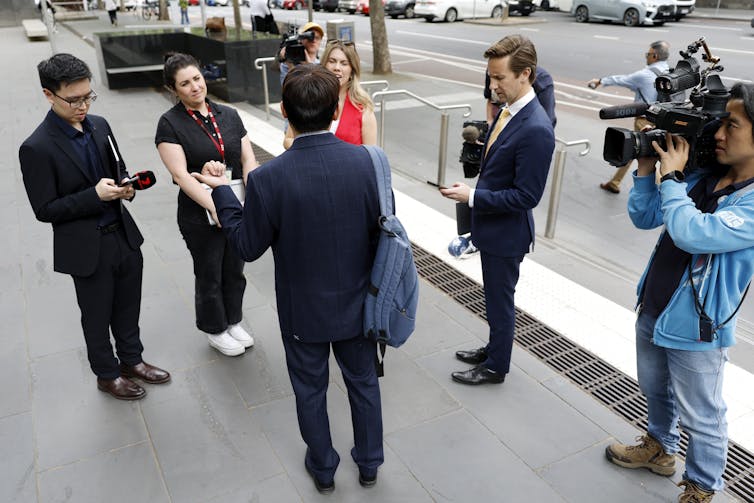
Several reporters said Victorian judicial officers are increasingly hostile toward the media, describing a “vibe shift” on the bench. Some recounted being removed from hearings, told they could not sit in court without submitting paperwork, or without a lawyer present.
Court media teams, which once held regular meetings with journalists and editors, no longer do so. Requests for meetings with chief judges have been declined or ignored. The researchers invited the chief magistrate, chief county court judge and chief justice of the Supreme Court to participate in the study, they all declined. This disengagement, we argue, is a finding in itself indicating little or no will from the Victorian courts in building trust with the public and media.
Access to government and police sources has weakened
Journalists also report declining access to human sources within police and the state government. Victoria Police no longer routinely provides the names of accused persons, making it harder for reporters to track the administration of justice on behalf of the public. Officers were described as increasingly reluctant to speak even off the record, fearing disciplinary action.
Within the state government, decision‑making authority over media access has become increasingly centralised in the premier’s private office. Some departments now provide statements with significant portions “on background”, information reporters may use but cannot attribute to its source.
A crisis for public accountability
Our benchmarking shows Australia already performs poorly by global standards of court transparency. Even within this context, Victoria stands out as one of the least open jurisdiction in the country.
Countries such as Sweden offer far greater public access to court files, including full police briefs and allow journalists to audio record court proceedings by default. The US and UK also provide broader access to court documents, supported by constitutional or statutory protections compared to Victoria and Australia.
Our report concludes that public interest journalism in Victoria is under significant strain, particularly in court reporting. The current situation threatens natural justice, democratic accountability and public trust in the legal system.
We make ten recommendations to the Melbourne Press Club in our report. Apart from a review of the implementation of the Open Courts Act Victoria, the core recommendation is the MPC acts as a facilitator to rebuild the broken relationship between the Victorian courts and the media outlets in the state. This would be in the public interest, which both the media and the courts should serve.
Authors: Johan Lidberg, Associate Professor, School of Media, Film and Journalism, Monash University