Modern Australian
The Times

Who could be Iran’s next supreme leader? And how is he chosen?

  • Written by Shahram Akbarzadeh, Director, Middle East Studies Forum (MESF), Deakin University

Since beginning their assault on Iran, that United States and Israel have been explicit that their ultimate goal is regime change.

The attacks are supposed to present a historic opportunity for Iranians to overthrow an authoritarian state and embrace democracy.

Yet, as the Iraq war in the early 2000s made clear, regime change does not necessarily bring a liberal alternative. It first destroys the existing order and creates a political vacuum. This is fertile ground for rival factions to fight it out and settle scores.

How a new supreme leader will be chosen

The US-Israel aerial campaign has targeted the regime’s leadership and its nerve system: Iran’s military bases, missile sites and strategic infrastructure. The supreme leader of Iran and its head of state, Ayatollah Ali Khamenei, is among the casualties.

While the authorities have moved fast to show they are still in charge, the death of the supreme leader is a shock.

The regime is now engaged in an existential battle for its survival. This makes the selection process for Khamenei’s successor all the more crucial.

The Iranian constitution sets out the mechanics of the succession process through a body called the Assembly of Experts. This is a collective of 88 Islamic religious scholars who have gone through a strict vetting process by the Guardian Council to confirm their loyalty to the supreme leader.
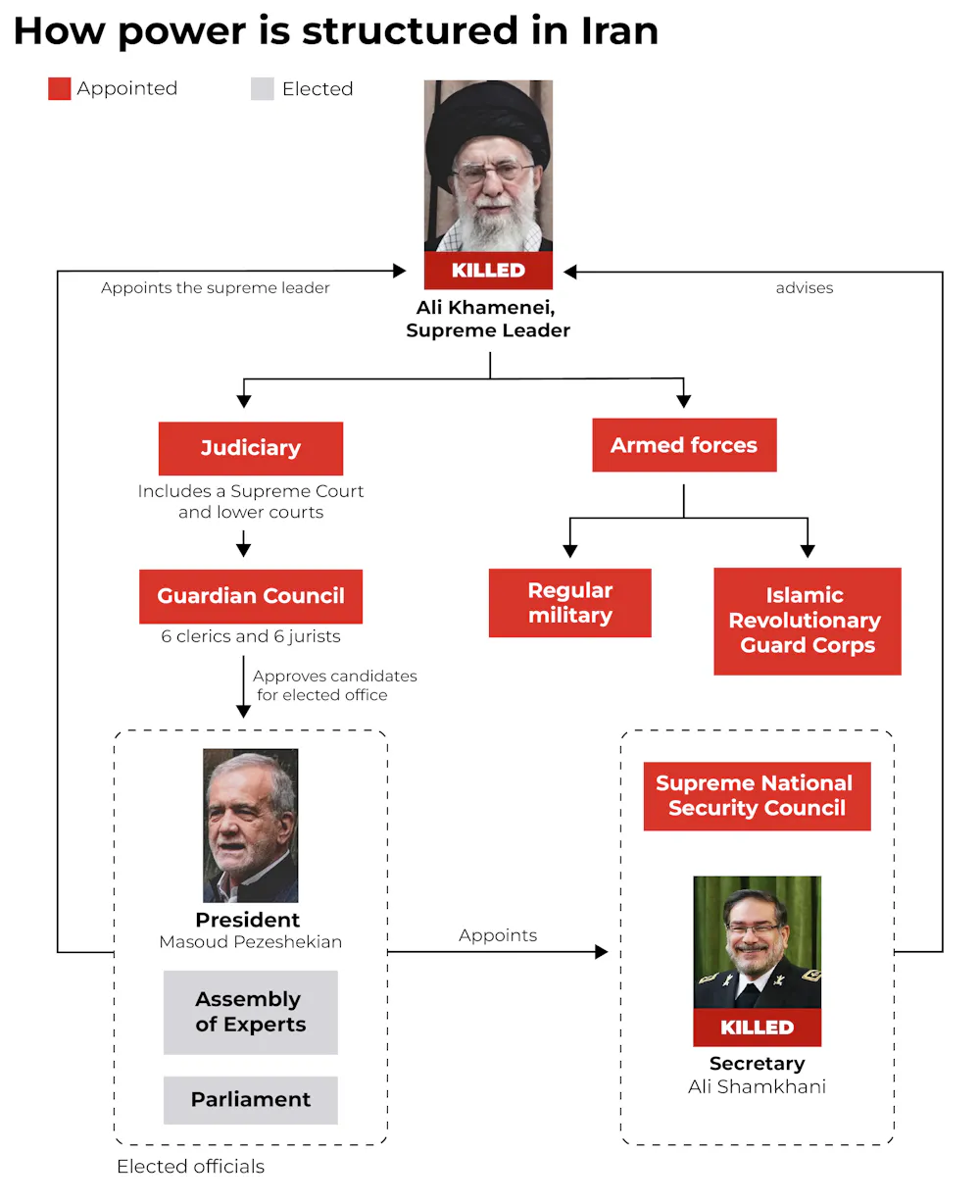
Iranian power structure flowchart
Council on Foreign Relations, Reuters, AAP The Guardian Council is responsible for ensuring compliance with the vision set out by the supreme leader. It consists of 12 men, half appointed by the supreme leader and the other half by the head of the judiciary (himself an appointee of the supreme leader). The council vets parliamentary candidates and bills, as well as nominations for the Assembly of Experts, which holds elections every eight years. The Assembly of Experts represents the conservative camp in the ruling regime, and it would look for the safest option for a new supreme leader. It will likely look for a successor who closely resembles Khamenei – resourceful and flexible enough to make tactical adjustments when necessary, but able to push hard against internal and external threats when it counts. This is not the time to take a chance with a “moderate” alternative. The Islamic Revolutionary Guard Corps (IRGC) will be advocating for a hardline successor, too. There are no obvious candidates at this point. The most likely successor had been President Ebrahim Raisi, who died in a helicopter accident in May 2024. Who could be Iran’s next supreme leader? And how is he chosen?
Mojtaba Khamenei in 2019. Vahid Salemi/AP

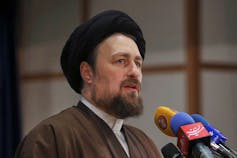
Those who could step into the role include Mojtaba Khamenei, the son of the deceased supreme leader, who has started appearing in more public events. Another possibility is Hassan Khomeini, the grandson of Ayatollah Ruhollah Khomeini, the founder of the Islamic Republic of Iran.
Who could be Iran’s next supreme leader? And how is he chosen?
Hassan Khomeini in 2015. Vahid Salemi/AP

But the wild card could be Alireza Arafi, who is currently a member of the Guardian Council, deputy chairman of the Assembly of Experts and director of Iran’s Islamic seminaries. He is a seasoned politician and has significant religious standing.

There is no explicit timeframe for the appointment of the next supreme leader. Given the immediate focus on the war effort, it may take some time. It could also be postponed to avoid putting a target on the successor’s back.

In the meantime, under the constitution, a three-person interim council was formed to make decisions. This council includes Arafi; the moderate president, Masoud Pezeshkian; and the hardline head of the judiciary, Gholam-Hossein Mohseni-Eje’i.

The three-person council currently running Iran. The three-person council currently running Iran. AAP, Wikimedia

Regional pressure building

Meanwhile, the IRGC has effective free rein to lead the fight against the US and Israel.

Pezeshkian, the president of Iran, is officially in charge of this effort as the head of the national Defence Council. But in practice, he is seen as a weak president with no real autonomy. He simply parroted Khamenei during the June 2025 war with Israel, and has given no indication he will try to chart a new course now. This may be expected, given Iran is under attack.

As a result, the combative IRGC is setting the agenda. We can see evidence of this in the closure of the Strait of Hormuz and Iran’s indiscriminate attacks on neighbouring states. For IRGC, this is not the time for a measured response, but for a show of military capabilities to punish the US-Israeli aggression. It appears to be acting according to a pre-prepared script.

Iran’s attacks on Persian Gulf countries hosting US military bases, such as the United Arab Emirates, Qatar, Bahrain and Kuwait, are burning bridges.

In recent years, Iran had worked hard to improve its relations with its Arab neighbours. It resumed diplomatic ties with Saudi Arabia in 2023 and was deepening its bilateral ties with the Saudis for the upcoming Hajj, the annual pilgrimage of Muslims to Mecca.

In return, members of six-country Gulf Cooperation Council called on US President Donald Trump to avoid a military confrontation with Iran in early January as his administration ratcheted up the rhetoric of regime change.

Now that these countries have been hit by Iranian missiles and drones, they will need to recalculate their options. They are reportedly considering ending their neutrality and striking back at Iran.

Trump has suggested the war could take four weeks. For Iran, time is on its side. As long as it can withstand the aerial strikes and inflict damage on the United States directly and indirectly – inflicting damage on the global economy – the regime will likely hold on to power.

Tehran expects that if it can hold out long enough, Trump will lose patience with the war effort and realise regime change is much harder than he anticipated.

Authors: Shahram Akbarzadeh, Director, Middle East Studies Forum (MESF), Deakin University

Read more https://theconversation.com/who-could-be-irans-next-supreme-leader-and-how-is-he-chosen-277360

Why Your Skin Breaks Out: The Science of Acne Explained

Acne is the most common skin condition in the world. An estimated 85% of people experience it at some point between the ages of 12 and 24, and a gro...

10 Swimwear Trends Australian Women Are Wearing This Summer

Every Australian summer brings a fresh wave of swimwear trends, but some styles have much greater staying power than others. While fashion constantly ...

Why Regular Skills Updates Are Essential for Licensed Security Officers

A guard at a Brisbane shopping centre gets a call about a shoplifter who's turned aggressive.  They’ve done the job for six years. But their de-...

10 Benefits of Choosing Professional Tutoring Penrith Services

Every student has unique learning strengths, challenges, and academic goals. While classroom teaching provides essential knowledge and structure, so...

Sunshine Coast Baby Classes Prove Big Hit Among First-Time Mums

There's a movement gaining traction on the Sunshine Coast, providing a village of support, socialisation and relief for first-time mothers and babie...

Father's Day Gift Ideas for Men Who Are Hard to Buy For

Some dads are easy to buy for. Others do not want anything, already have everything, or give you the classic "don't worry about me" answer every yea...

Top 5 Mistakes That Wear Out Your Brakes Faster

Brakes don't need frequent replacements like oil changes do.   But a lot of the wear happens quietly, over months, because of habits most drivers...

Plantation Shutters vs Curtains: Which Is Better for Your New Home?

Moving into a new home is an exciting opportunity to personalise your space and make it your own. While many homeowners focus on furniture, flooring...

Celebration of Life vs Traditional Funeral: What's the Difference?

When saying goodbye to someone you love, there is no single way to honour their life. Every family has different traditions, beliefs, and preference...

Building Approval for Roofing Projects: What Homeowners Need to Know

Roofing projects are an important part of maintaining and protecting your home. Whether you're repairing storm damage, replacing an ageing roof, or ...

Chatswood Tutoring And Its Role In Academic Achievement

Academic success often requires more than classroom attendance alone. Students face increasing expectations as they progress through school, particu...

Why Laser Hair Removal Treatments Continue Growing In Popularity

Managing unwanted hair can become time-consuming and frustrating for many people, especially when shaving, waxing, and other temporary methods requi...

Choosing the Right Devices for a Flexible Workplace

For IT leaders managing large fleets, the device layer is where workforce productivity and security policy meet. The shift towards flexible and hybrid...

How Business Advisory Services Help Companies Achieve Sustainable Growth

Every business owner aims to build a profitable and sustainable organisation. While dedication, innovation, and hard work are important, achieving l...

Why Body Contouring Has Become A Popular Cosmetic Treatment

Many people maintain healthy lifestyles through regular exercise and balanced eating habits but still struggle with stubborn areas of fat that are d...

How to Choose the Right POS Hardware for Your Business in Australia

A lot of Australian business owners spend weeks researching POS software but buy hardware almost as an afterthought. That's a mistake. The wrong har...

Why Material Handling Hose Is Critical for Industrial Efficiency

A high-performance material handling hose is an essential component in industries that transport abrasive, dry, or bulk materials on a daily basis...

How to Choose the Right Lawyer in Melbourne for Your Situation

Choosing legal support can feel difficult, especially when the stakes are personal or business-related. The right lawyer in Melbourne should underst...