Labour-National standoff aside, the India-NZ trade deal is a blueprint for real growth
- Written by Rahul Sen, Senior Lecturer, Department of Economics and Finance, Auckland University of Technology
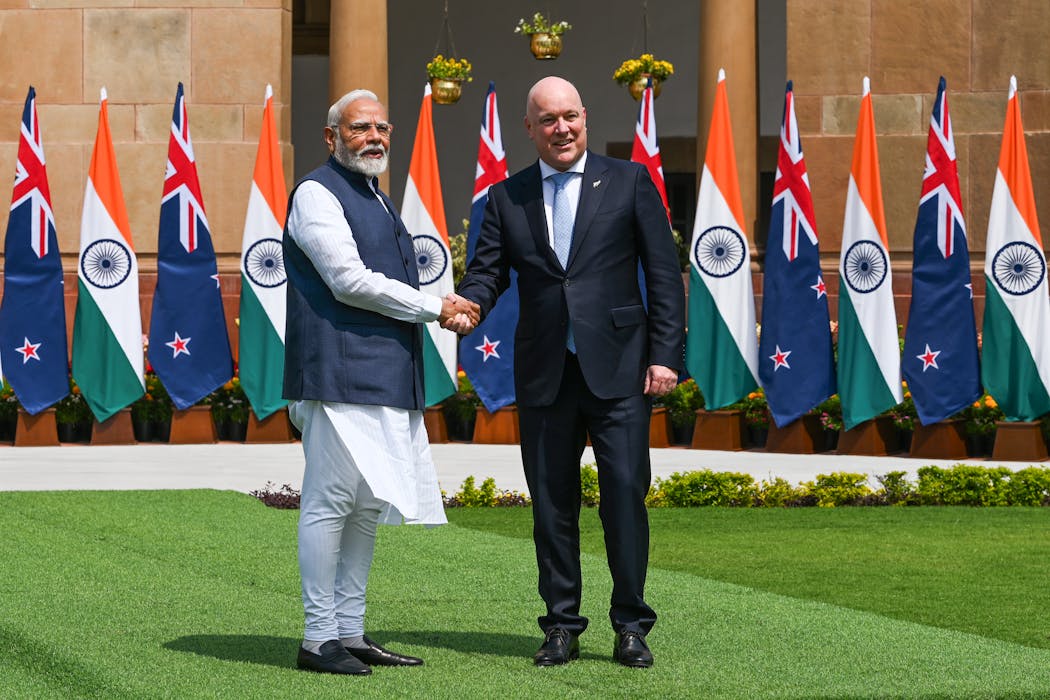
In an increasingly uncertain world, where the global balance of power is tilting toward Asia, a comprehensive free trade agreement (FTA) with India promises access to a booming market and “southern anchor of stability” in the Indo-Pacific region.
But there is devil in the detail, with coalition partner NZ First opposing the deal, meaning the government needs Labour’s support – conditional on several demands being met – to get it over the line.
With that political support seemingly still in limbo, it’s important to look beyond the immediate domestic agenda and understand the potential economic and strategic value of the deal.
Some of this is obvious. India is now the world’s fastest-growing major economy, currently valued at US$4.2 trillion in GDP, and poised to contribute 17% of global economic growth in 2026. India and China will soon generate nearly half of the world’s total economic growth.
Unlike traditional “buy and sell” trade pacts, however, the India-New Zealand deal doesn’t focus solely on the exchange of goods. It will be a comprehensive economic partnership.
It leverages India’s massive workforce and scale against New Zealand’s high-value technology and capital, built around cross-border movement of skills, technology and investment.
Strategic realism
The potential economic wins for New Zealand’s primary sectors are substantial. Exporters of wood, sheep meat, wool, coal and hides will see tariffs drop to zero immediately, generating estimated annual savings ranging from NZ$45–$62 million over the next five to ten years.
Exporters of apples, kiwifruit and mānuka honey will benefit from incremental market access each year through tariff-rated quotas. When the FTA takes effect, for example, mānuka honey exports to India can grow from 14 to 200 metric tonnes annually, with tariffs reduced from 66% to 16.5% over five years.
(As an example of the market potential, an entire shipment of Rouge apples from Hawkes Bay sold out in an Indian wholesale market within a day last year.)
More generally, the trade deal is built on “strategic realism”, where both sides balance long-term economic gains while safeguarding their national interests.
New Zealand will share its world-leading farming technology and orchard management skills to help Indian farmers improve quality and yield through new “centres of excellence”. In return, India lets more premium New Zealand products into its shops.
And while India remains cautious about opening its dairy sector to competition, New Zealand now becomes a partner in its dairy supply chain, providing high-value milk proteins for Indian nutrition products.
New rules also cut red tape. Perishable goods exported to India will clear customs within 24 hours, saving New Zealand businesses time and money.
Investment and innovation
A unique component of the agreement is the commitment for New Zealand businesses to invest US$20 billion in India over the next 15 years. Firms can test ideas in India, then sell that technology across Asia.
The deal will allow New Zealand firms to utilise India as a processing base for global sales, improving their competitiveness while bringing home royalties and innovative technical knowledge for future growth.
To facilitate this, India will establish a bespoke “New Zealand desk” for investor guidance. Working groups for economic and technical assistance will be established in key sectors, with investment opportunities in:
• green energy – leveraging New Zealand’s geothermal expertise to help India reach its own net zero goals by 2070, based on its 2025 geothermal energy roadmap
• services – gaining “most favoured nation” access to more than 100 Indian service sectors, including engineering and education
• creative – opening doors for film makers and creating a path for rongoā Māori (traditional health) practitioners to share their skills
• finance and AI – helping New Zealand technology firms learn from India’s evolving digital public infrastructure and payments systems.
By 2048, it’s estimated New Zealand will need 250,000 more workers. The India trade deal can help by allowing temporary employment entry visas for 5,000 Indian professionals, such as doctors and engineers.
These three-year, non-renewable visas are designed to fill specific critical skill shortages in New Zealand, without affecting local wages or housing.
Blueprint for growth
Once the trade agreement is signed, New Zealand exports to India are expected to more than double in value over the next decade.
But the strategic significance of the deal extends beyond bilateral trade. It positions New Zealand as a potential gateway for India into the Pacific.
In turn, that can open opportunities for New Zealand to expand its exports and investments to the Pacific through Indian partners.
To fully realise the trade agreement’s potential, New Zealand will need to support and prioritise direct connections between the countries, including through direct flights and investment in local relationships based on targeted research.
If things go well, India is on track to become one of New Zealand’s top five trading partners. The free trade agreement provides the blueprint for that to happen.
The author acknowledges the valuable input of Dr Sadhana Srivastava as part of ongoing research into investment-led trade with India.
Authors: Rahul Sen, Senior Lecturer, Department of Economics and Finance, Auckland University of Technology