Are Google’s ‘preferred sources’ a good thing for online news?
- Written by T.J. Thomson, Associate Professor of Visual Communication & Digital Media, RMIT University
Why do you see the results you do when you search for information online? It’s a complex mix of what the source is, its relationships to other sources online, and your own past browsing history and device settings.
But this formula is changing. Rather than being passively served content that search engines decide is most relevant (or businesses have paid to have promoted), some big tech platforms have started providing users more control over what they see online.
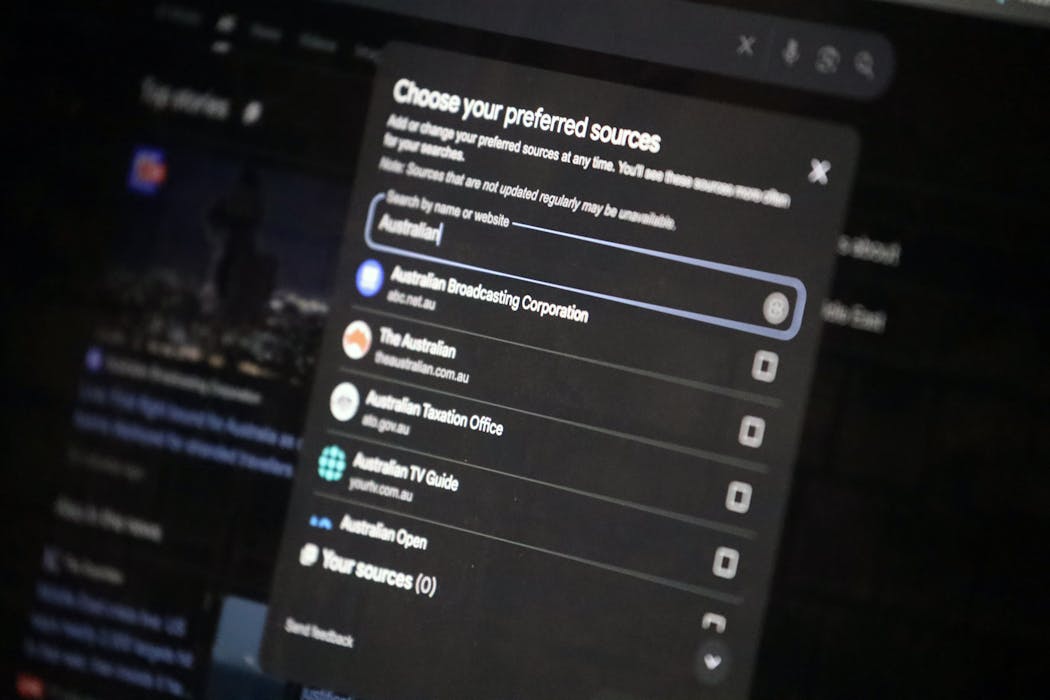
Earlier this year, Google launched the Preferred Sources feature in Australia and New Zealand. Through it, users can select organisations that are “preferred” and whose content they’d like to see more of in relevant search results.
In response, a raft of organisations, from news outlets to big banks, have started inviting their audiences and customers to choose them, with instructions on how to use this feature. News outlets such as the ABC, News.com.au, RNZ and The Conversation have all done so, among many others.
If you decide to use this new feature, there are potential benefits – but there can be unintended outcomes as well.
Where do you get your news?
In Australia, more adults say they get news from social media (26%) than from online news websites (23%). This means that a feature like “preferred sources” might influence readers who get their news from search engines. But it won’t affect users who primarily get their news from social media apps.
Trading phones with someone and looking at their browsing history or recommended YouTube videos reveals just how much personalisation influences what we see online.
Big tech companies are known to harvest large amounts of data, making money in an attention economy from audience engagement. They also make money from knowing more about their users so they can sell this information to advertisers.
Much of the internet is governed by invisible algorithms – hidden rules dictating who sees what, for which reasons. Algorithms often prioritise content that is engaging and sensational, which is one reason why misinformation can flourish online.
As helpful as it can be to get recommendations of products to buy or Netflix shows to watch, based on your history, when it comes to voting and politics, recommendations become much more fraught.
Our own research has shown people’s online news and information environments are fragmented, complex, opaque, chaotic and polluted, and that users desire more control over what they see. But what are the potential impacts of this?
More control is good
At face value, more control over what we see online is a positive and empowering thing.
This rebalances the equation from the loudest, most popular, or wealthiest voices – or ones that manipulate algorithms the most – to the ones users are actually interested in hearing from.
It potentially also helps with cognitive overload. Rather than having to spend the time and mental energy to decide on a case-by-case basis whether each source you encounter is trustworthy, making this decision once for particular news brands or organisations can make engaging with search results more relevant and efficient.
But a lack of balance is risky
However, the voices people want to hear from aren’t necessarily the ones that are best for them. As with any choice, you need a level of maturity and critical thinking to act responsibly.
As data companies, search engines benefit from knowing ever more information about user behaviour and preferences. Knowing which media outlet you prefer may in some cases indicate your political party preferences. Knowing that you prefer sports news over celebrity news can help companies target you with advertising more effectively.
In addition, more choice could potentially affect the diversity of people’s media diets. Just like with food diets, if people rely too much on low-quality media, over time that may affect their opinions, attitudes and behaviours. This has important implications for democracies that rely on well-informed and engaged citizens to cast votes.
There’s also a risk in conflating news sources with other types of sources. Journalists at news organisations are often held accountable to professional codes of conduct that, for example, aim to prevent reporters from personally benefiting from their reporting.
In theory, this allows audiences to receive independent analysis on important topics with confidence that the source has fact-checked claims and doesn’t have a vested interest in the reporting.
But if you select a business – such as the blog of a hardware store or a bank – as a source, you don’t have those same guarantees around editorial codes of conduct and professional ethics.
Should you use this feature?
Overall, allowing users more control over what they see is a good thing. But appropriate governance and regulation – possibly championed by Australia’s Digital Platform Regulators Forum – is needed to ensure people’s privacy and that their source preferences aren’t unfairly monetised.
Being more involved in your media diet is a positive step, as is thinking about its balance and diversity.
Ensuring a mix of sources across types (think local, regional, national, and international) and varieties (political, social, sports, entertainment news, and so on) can lead to a better balance.
Also think about whether the sources you are relying on are based on opinions or on facts. Doing this and actively creating a high-quality media diet is better for you and for others in your community.
Authors: T.J. Thomson, Associate Professor of Visual Communication & Digital Media, RMIT University
Read more https://theconversation.com/are-googles-preferred-sources-a-good-thing-for-online-news-277372