Iran’s regime has shut down the internet in the middle of war – placing civilians in the crosshairs
- Written by Amin Naeni, PhD Candidate in International Relations, Deakin University; Dublin City University
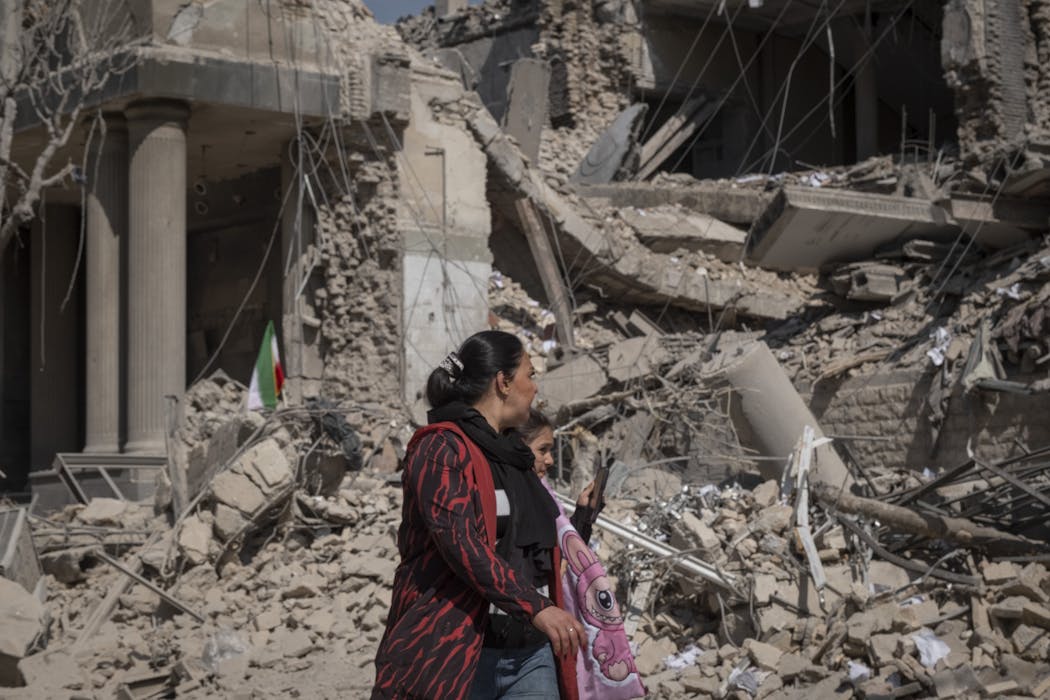
On February 28, hours after the United States and Israel launched attacks on Iran, the Iranian regime imposed a nationwide internet shutdown.
Roughly one week into the conflict, it is estimated only around 1% of normal internet traffic remains accessible across the country.
This represents one of the rare instances in modern history in which a government has almost entirely disconnected its own population from the internet during a major military crisis.
The risks this creates can be fatal. Civilians are unable to access real-time information about imminent attacks – and are more likely to get caught in the crosshairs of war.
At the same time, Iranian officials have launched a propaganda campaign to target US audiences online, revealing a cruel irony for Iranian citizens.
An advanced architecture
Over the past two decades, the Iranian regime has developed an advanced architecture for internet shutdowns. This is centred on a system known as the National Information Network.
This system is designed to prevent public access to the global network and provide a national intranet. Basic services such as Google become unavailable. But government websites, local banking services, and selected national platforms remain operational.
This allows the state to retain extensive control over citizens’ online activities. It is also a way to protect the regime from international scrutiny.
The regime has previously deployed this system during major waves of nationwide protests in 2019 and January of this year.
But the current shutdown is occurring in a very different context. And it comes with even more severe consequences.
Preventing protest at the expense of civilian safety
The gap between the state and society in Iran has widened to unprecedented levels over the past decade. This is largely thanks to the multiple waves of nationwide protests.
In January, hundreds of thousands of people took to the streets across the country. In response, the government shut down the internet and killed thousands.
Now, the authorities fear protesters could use digital platforms to organise a new round of street mobilisation amid the US and Israel’s ongoing bombing campaign.
Iranian security institutions have repeatedly warned the public, through state media and mass text messages, that any street presence will be treated as “direct cooperation with the enemy” and will be met with a severe crackdown.
This is particularly significant in light of US President Donald Trump presenting US military actions as a promise to “rescue” Iranian protesters who faced the crackdown in January.
Viral videos of celebrations among Iranians welcoming US involvement have increased pressure on authorities.
At the same time, the regime has come under intense military pressure from the US and Israel. This dynamic has made controlling the information environment a priority for the Iranian leadership.
By creating an information vacuum, they seek to ensure only the official narrative circulates domestically.
Milad Alavi, a journalist in Tehran who managed to circumvent the severe restrictions, highlighted the level of state control in a post on X:
This tweet was sent via an Open VPN file after 6 hours of effort and testing over 59 V2ray links, several NPV files, and with the help of one of my friends. Internet in Iran, whether fixed or mobile, is cut off. We are left in the dark, and on state TV, Iran is on the verge of conquering Tel Aviv and Washington!
Endangering civilians
The current digital blackout in Iran is putting civilians in great danger.
Many of Iran’s nuclear and missile facilities, as well as other strategic targets, are located within urban areas. In several cases, the Israeli military has issued evacuation warnings through social media ahead of attacks.
However, due to the internet shutdown, Iranian citizens often have no access to these notices. Iran also lacks a functioning air-raid warning system, and public shelters are absent.
Put simply, civilians receive no real-time information indicating whether they should evacuate buildings or remain in place during attacks.
As a result, the internet shutdown has transformed from an issue of restricting information flows into a crucial matter of civilian safety.
An international propaganda campaign
Iranian civilians might be disconnected from the global internet. But Iranian officials and their key supporters remain actively engaged on foreign online platforms.
In fact, senior government figures have sought to launch an information operation on X. This operation seeks to influence international public opinion and pressure the White House to end the war.
A key effort is to target segments of Trump’s political base associated with the America First movement.
For example, Iran’s Foreign Minister, Abbas Araghchi, claimed:
Trump has turned “America First” into “Israel First” – which always means “America Last”.
This is one of many English-language posts Araghchi has made since the beginning of the war which advance the narrative that Trump has “betrayed” his own voters by prioritising Israel’s interests over those of the US.
Ali Larijani, secretary of Iran’s Supreme National Security Council, has echoed this line of messaging.
In a recent post on X, he said it is very sad that Trump is “sacrificing American treasure and blood to advance [Benjamin] Netanyahu’s illegitimate expansionist ambitions”.
Iranian officials’ expressions of concern for the lives of US soldiers represent one of the clearest ironies of this information campaign.
For more than four decades, the ruling regime has promoted the slogan “Death to America” as a central element of its ideological discourse and foreign policy approach.
Yet Iranian authorities now invoke the risk of American casualties in an effort to shape US public opinion.
Another paradox is also evident.
While ordinary Iranians remain cut off from the internet with their safety at risk, officials continue to operate freely online, directing messages to US audiences.
Authors: Amin Naeni, PhD Candidate in International Relations, Deakin University; Dublin City University