

Banning protest slogans won’t end antisemitism. We need to understand the complex forces driving it
- Written by: Imogen Richards, Senior Lecturer in Criminology, Deakin University
The Royal Commission on Antisemitism and Social Cohesion will deliver its interim report to the governor-general by April 30. Public hearings will follow, defining antisemitism and its effects on Jewish Australians.
As a researcher of political violence, I provided a submission to the NSW parliamentary committee considering prohibitions on slogans that some argue incite hatred and violence against Jews, such as “globalise the intifada”.
In the wake of the Bondi Beach attack in December, the political debate in Australia has directed an inordinate amount of attention to these protest slogans as a source of antisemitism.
This focus rests on a flawed premise about what is driving contemporary antisemitism.
Antisemitism is a serious and persistent problem. And any effective response must begin with a clear recognition of its causes and harms.
Treating protest speech as the primary problem risks misidentifying where the most serious dangers lie.
Neo-Nazism: the most explicit threat
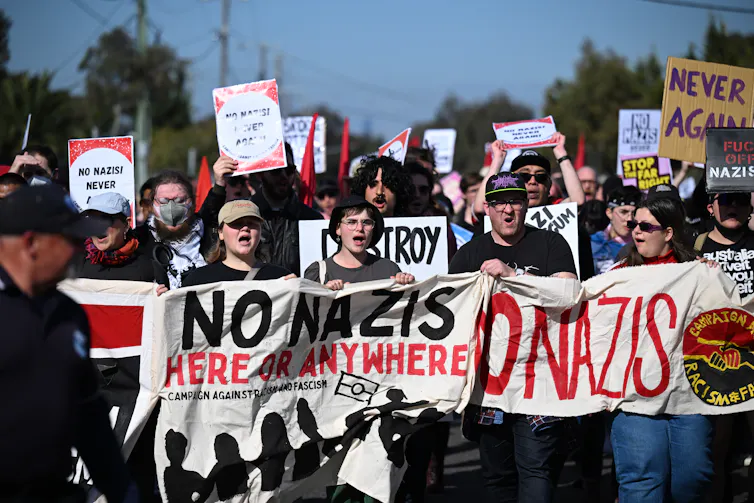
The most overt form of antisemitism in Australia comes from extreme right and neo-Nazi movements.
For these groups, hostility toward Jewish people is foundational. Their narratives cast Jewish people as hidden forces behind both the international financial system and revolutionary socialism. In this framing, Jewish people are falsely portrayed as an all-powerful, transnational enemy operating above the nation-state.
These tropes date back to interwar fascist movements in Europe, and continue to feature at the centre of the worldviews espoused by neo-Nazi groups today.
In Australia, groups such as the National Socialist Network have distributed propaganda outside synagogues and Jewish schools, and used social media to glorify Nazi iconography.
These movements aim not only to intimidate Jewish Australians, but to normalise Nazi symbols and ideology in public life.
The far right’s conditional embrace of Israel
Somewhat paradoxically, parts of the far right have also embraced conditional philosemitism in recent years.
This is expressed as an admiration for Jewish people, culture or history. However, it is not a genuine regard for Jewish people. Rather, the far right uses it as a strategic rhetorical stance.
Across Europe, the United States and Australia, far-right movements have adopted ostensibly pro-Jewish and pro-Israel positions to mobilise opposition to migration, particularly from Muslim-majority countries, and deflect accusations of racism.
Yet, these groups continue to circulate antisemitic conspiracy narratives, including:
“globalist” Jewish elites allegedly orchestrating “mass migration” to engineer the demographic “replacement” of white majorities
Jewish intellectuals supposedly driving moral and cultural decline through progressive social movements.
These false narratives are evident in European far-right parties with long antisemitic histories, including Germany’s Alternative für Deutschland (AfD), France’s National Rally, and Italy’s Lega. Each has adopted pro-Israel positions while members continue to circulate antisemitic tropes.
In Australia, One Nation has taken strongly pro-Israel positions since the October 2023 Hamas attacks.
Yet, Pauline Hanson has long deployed rhetoric that critics associate with far-right traditions. For example, she has warned of “globalist” elites and a “great reset” following the COVID pandemic. This language overlaps with conspiratorial narratives, including those present in white supremacist “great replacement” theories.
In her 1997 book, she also described Indigenous Australians’ status in society as “the Aboriginal question”. This construction arguably echoes the 19th-century antisemitic trope of “the Jewish question”, later radicalised and weaponised under Nazism.
Neo-jihadist rhetoric against Zionism
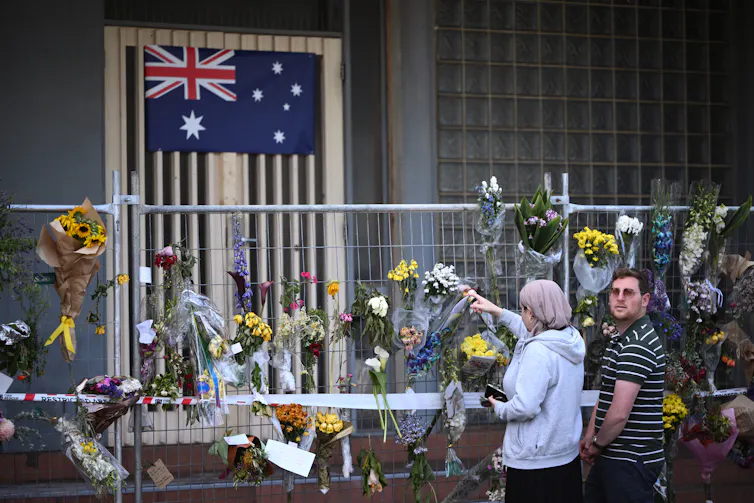
Following the Bondi attack on a Hanukkah gathering in December, attention immediately focused on the alleged attackers’ ties to the Islamic State organisation.
Investigative journalists have reported that security officials believe the attack may have been motivated by Israel’s war on Gaza. Court documents indicate the alleged gunmen also filmed a video condemning “Zionists” before the attack.
In addition, researchers have suggested the attack was likely inspired by an Islamic State speech urging attacks on Jews.
This reflects a distinct ideological logic.
Within neo-jihadist movements, antisemitism is tied to hostility to Zionism. However, this does not necessarily translate into opposition to Israeli state policies.
Although Osama bin Laden invoked Palestinian suffering, neither al-Qaeda nor Islamic State consistently treated the Israeli-Palestinian conflict as a primary driver of their actions.
Zionism is instead framed as a global conspiratorial force. Jewish people are cast as agents within a system that collapses any distinction between Jews, Israel and Western states. In this worldview, they are all depicted as a single existential enemy of Islam.
State-directed antisemitic violence
Iran’s Islamic Revolutionary Guard Corps (IRGC) has long targeted Jews internationally. In Argentina, for instance, a criminal court found Iran responsible for the bombing of a Jewish community centre in 1994 that killed 85 people.
In August 2025, the Australian government, citing ASIO intelligence, said Iran was behind the firebombing of Lewis’ Continental Kitchen in Sydney and the Adass Israel Synagogue in Melbourne.
This violence differs from neo-jihadist groups, who draw on Salafi-jihadist interpretations of Islam to legitimise their actions. By contrast, the IRGC operates within a framework of Khomeinist Shia Islamism. In this, religious authority is fused with state power and geopolitical strategy.
Their targeting of Jewish communities abroad is therefore driven by Iranian statecraft. The objectives are maintaining deterrence, regime survival and projecting power. And Jewish communities outside Israel are positioned as proxies through which Iran can exert pressure on the Israeli state.
Antisemitism within protest movements: real but distinct
Antisemitism has appeared in some pro-Palestinian activism in Australia, and this warrants serious attention. Jewish students have experienced harassment and intimidation, including at cultural or religious events.
However, such conduct does not reflect the core beliefs of the pro-Palestinian movement. Organisers have challenged antisemitic language when it has emerged, including at the March for Humanity in Sydney last year.
And across Australia, antisemitic incidents more commonly involve verbal abuse, online messages, graffiti, posters and property attacks, many unrelated to protest activity.
Policies that criminalise pro-Palestinian speech risk overlooking the deeper reasons Jewish people have been targeted historically.
More fundamentally, the conflation of Jewish identity with the state of Israel – advanced by far-right actors and, at times, by government policy – may deepen rather than reduce antisemitism. Treating all criticism of Israel as antisemitic reinforces the premise that Jewish people bear collective responsibility for the actions of the Israeli state.
If we are serious about addressing antisemitism, we need to engage with the complexities that underpin it.
Authors: Imogen Richards, Senior Lecturer in Criminology, Deakin University


















