

Pandemic policing needs to be done with the public's trust, not confusion
- Written by Darren Palmer, Associate professor, Deakin University
The law on what we can and can’t do during the coronavirus outbreak is changing on an almost hourly basis. Some of what is written now might be overtaken by the shifts in the pandemic powers of control.
But we need to make sure people have trust in any new powers given to authorities. These need to be clear to all, and applied consistently and transparently, which is not the case at the moment.
For example, over the weekend a Victorian teenager was fined A$1,652 for leaving home to go for a driving lesson with her mother. Police said their activities were “non-essential travel”.
The advice from New South Wales police at that time said such activities were fine in NSW. Victoria police have since withdrawn the fine.
But NSW Police Commissioner Mick Fuller told the ABC’s Fran Kelly that in NSW you cannot travel to your holiday home unless it is “essential”. Victorians are told they can head to their holiday homes over Easter as long as they otherwise maintain strict quarantining on arrival.
Read more: Coronavirus has seriously tested our border security. Have we learned from our mistakes?
These are just two examples in two states of a broader underlying problem that Americans would deem unconstitutionally “void for vagueness”, a law invalid because it’s not sufficiently clear.
Calls for common sense do little to ease concerns that things are likely to worsen. The broad coronavirus containment and mitigation strategies might continue for many more months.
Remember the Fitzgerald inquiry
Perhaps we can learn from the landmark Fitzgerald inquiry into Queensland policing, more than three decades ago.
Read more: Thirty years on, the Fitzgerald Inquiry still looms large over Queensland politics
The inquiry identified widespread systemic corruption in police, politics and civil society. This inquiry represented a change in police accountability.
There is another, lesser-known or appreciated aspect of the Fitzgerald inquiry. It emphasised that police must have the consent of the community: police have to ensure their practices generate trust that people will be treated fairly and police discretion will be used appropriately.
These are standard issues in the policing scholarship.
Pandemic policing raises many issues that cut to the core of policing by consent.
How policing resources are mobilised and the decision-making processes and practices on the ground are vital. Just look at the confused circumstances of the disembarkation of the Ruby Princess cruise ship in Sydney, which has been a key cause of the spread of COVID-19 in NSW and beyond.
The Australian Border Force, NSW health authorities and NSW police were variously blamed, so surely there needs to be a major investigation into network failure and specific responsibilities.
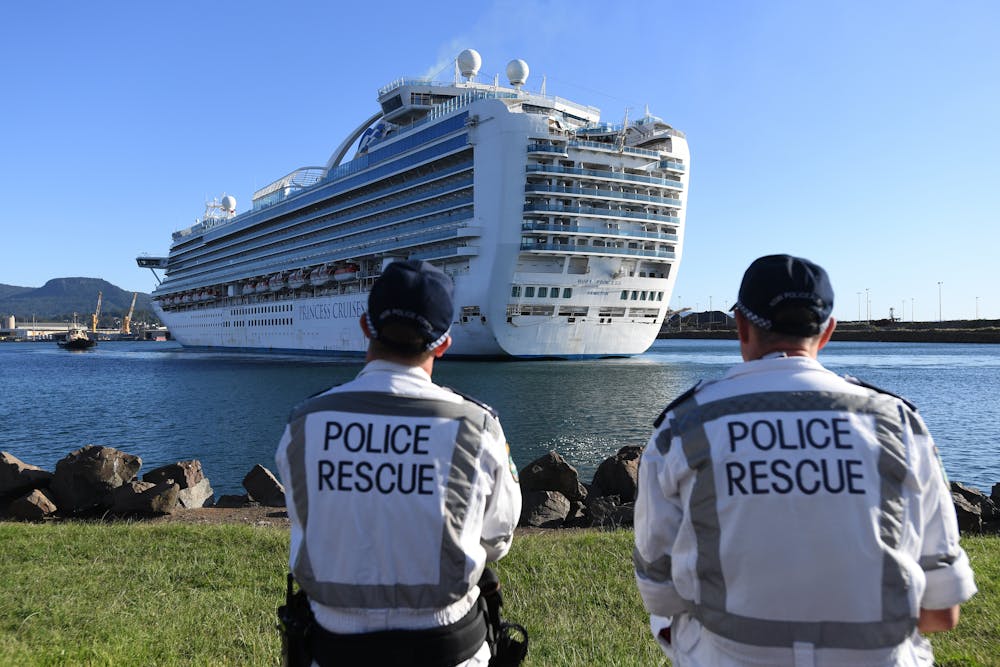 The Ruby Princess at Port Kembla in NSW.
AAP Image/Dean Lewins
The Ruby Princess at Port Kembla in NSW.
AAP Image/Dean Lewins
Police discretion needs to be fair
Everyday street policing is central to pandemic policing: when do police decide to intervene and ask someone their purpose for being out and about?
Vague legislative provisions are often the source of poor use of discretion by police. But the answer is not to be found in taking away any discretion, the hallmark of “zero-tolerance policing”.
There are many things that might be done, but a few simple ones come to mind.
Any legislation or regulation must be precisely drafted. This has not been happening and is causing confusion. Just look at the level of uncertainty in NSW, Queensland and Victoria.
We need clearly stated offences, clear lines of reasoning and a clear demarcation between preferred practice or guidance and regulated conduct.
For instance, what does staying in your own “area” for permitted out-of-home travel mean?
A discussion on ABC radio in Melbourne recently descended into callers chastising a man who thought he would like to travel to the beach for exercise well away from his residence. Live on air, he asked Victoria Police Chief Commissioner Graham Ashton if that was okay.
The chief commissioner didn’t say yes or no, he just called for “common sense”. But what would be reasonable and common sense – 1km, 2km, 5km or 10km, etc? Is driving to exercise allowed?
More than common sense
Common sense is not the way to ensure police discretion is going to be used appropriately, nor does it give the community confidence in the law. It might only be the odd case here and there at the moment causing confusion or consternation but it is changing daily.
Data on the use of this discretion must be recorded and made publicly available in close to real time. Equally important is the need to have data on policing activities.
Most jurisdictions have a crime statistics agency and these agencies should be given responsibility to collate data to identify who is being stopped, where, for what offence and with what outcomes. Report this every day as we do health data.
It does not need to be data on the final outcome that determines whether the fine is paid or challenged in the courts some months later. But it needs to reflect the immediate policing activities and it needs to be made public and in a timely manner.
Read more: A matter of trust: coronavirus shows again why we value expertise when it comes to our health
As the pandemic continues, and it may get worse, pandemic policing might head in directions the broader population has never experienced.
So 30 years on from Fitzgerald, we need to reinforce the notion that policing by consent, with transparency and accountability, is vital.
If public support is to be maintained over the course of the pandemic we need to make sure we have legal clarity and a detailed understanding of what is being done in the name of the exception. Pandemic policing must have very real limits and robust, real-time accountability.
Authors: Darren Palmer, Associate professor, Deakin University

















