

The coronavirus supplement is the biggest boost to Indigenous incomes since Whitlam. It should be made permanent
- Written by Francis Markham, Research Fellow, College of Arts and Social Sciences, Australian National University
On March 23 the government effectively doubled payments to the unemployed, single parents and students, introducing a new unconditional Coronavirus Supplement to go on top of existing allowances such as Newstart, Youth Allowance, Parenting Payment, Austudy and Abstudy.
From April 27 single unemployed adults will get around A$557.85 per week in income support, almost double the previous $282.85 per fortnight.
This additional support is time-limited, applying for only six months.
As well as covering the newly unemployed, it’ll extend to existing recipients, meaning it’ll be paid to about 2.3 million Australians.
At the same time, the onerous requirement for recipients in remote Australia to conduct “work-like activities” or face fines and suspensions, has itself been suspended because work-like activities carry added risk.
The temporary doubling is intended to shield those who find themselves unable to find work at a time when the government has shut down large sections of the economy.
But it will have another (welcome) unintended consequence: it will temporarily cut poverty among Indigenous Australia to new lows.
Most very remote Indigenous Australians live in poverty
The income support system has failed for decades to keep Indigenous people out of poverty. At the time of the 2016 Census, 31% of Indigenous Australia lived below the poverty line of $404 per week.
And while the overall financial situation of Indigenous Australians improved over the decade from 2006 to 2016, in very remote Australia, poverty got worse.
Already alarmingly high in 2006 at 46%, by 2016 the proportion of very remote Indigenous Australians in poverty had climbed to 54%.
Percentage of Indigenous population living in poverty
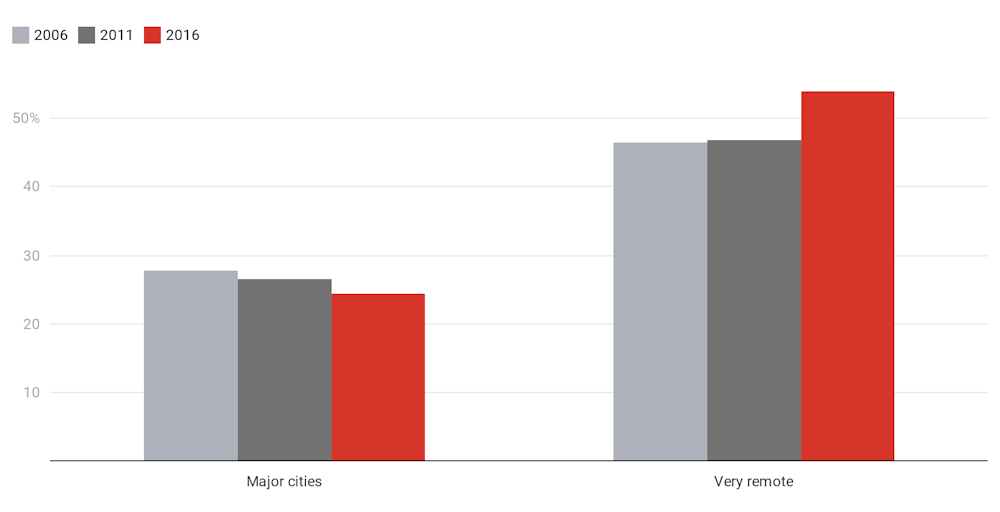 Indigenous poverty rates using the ‘50% of median disposable equivalised household income’ poverty line.
Markham and Biddle, 2018
Indigenous poverty rates using the ‘50% of median disposable equivalised household income’ poverty line.
Markham and Biddle, 2018
Since then things have changed, for the worse.
According to Bureau of Statistics survey data, median Indigenous personal incomes fell from $482 per week in 2014-15 to $450 in 2018-19.
In remote Australia the fall was more precipitous.
Over those five years remote median Indigenous personal income fell from $375 per week to $310.
Median Indigenous income, 2014-15, 2019-19
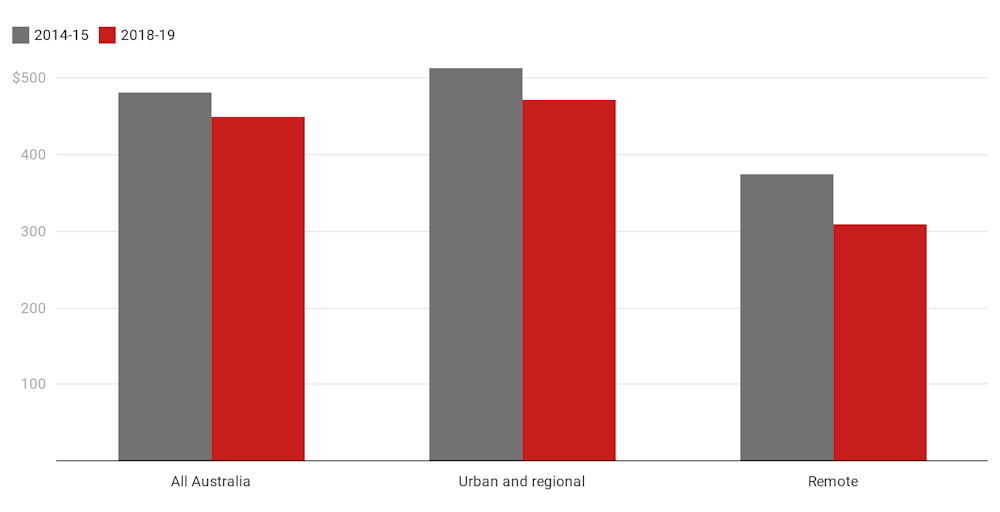 Median gross personal weekly income, Indigenous population aged 15-64.
Author's calculations from the National Aboriginal and Torres Strait Islander Social Survey 2014-15 and National Aboriginal and Torres Strait Islander Health Survey 2018-19
Median gross personal weekly income, Indigenous population aged 15-64.
Author's calculations from the National Aboriginal and Torres Strait Islander Social Survey 2014-15 and National Aboriginal and Torres Strait Islander Health Survey 2018-19
The Coronavirus Supplement is set to dramatically change things.
Before the coronavirus outbreak about 27% of the Indigenous population aged 16 years or older were receiving payments that make them eligible for the Supplement.
The proportion who will actually get it be much greater, as many more will become unemployed or underemployed as a result of the crisis.
Read more: Three charts on: the changing status of Indigenous Australians
Indigenous workers are likely to be especially hit hard by the downturn due to discrimination and their more-precarious employment status.
The extra $225 per week is well-targeted at the poorest Indigenous Australians.
According to my estimates, around 38% of Indigenous adults in very remote areas will be eligible.
The biggest boost in 50 years
It is likely to be the most substantial increase in aggregate Indigenous incomes since Indigenous people won rights to equal wages and the full range of social security payments between 1969 and 1977.
In very remote areas, total community incomes are likely to increase by one quarter.
Indeed, so significant is the boost that remote community stores may run out of food as incomes start to catch up with people’s everyday needs, a concern expressed by the minister for Indigenous Australians Ken Wyatt.
It should be made permanent
It would be misguided to think Indigenous Australians need only temporary relief.
The Indigenous economy has been in crisis since 1788. The unemployment rate in places like Palm Island was 60% before the coronavirus hit.
The average duration of unemployment for Indigenous Australians is 73 weeks.
For Australia as a whole, it is 11 weeks.
Read more: Census data shows just how bad we've been at closing inequality gaps
The unfavourable job market now facing many Australians for the first time has been the normal state of affairs for many Indigenous people.
For this reason, the temporary increase to income support should be made permanent, and the suspended mutual obligation requirements abolished.
Doing so, and normalising some of the anomalies of the current arrangement (such as the exclusion of disability support pensioners, age pensioners, and temporary residents) would provide all Australians with an income floor below which no one could fall.
Read more: It's Newstart pay rise day. You're in line for 24 cents, which is peanuts
For Indigenous Australians, it would lock in the biggest reduction in poverty rates since the 1970s.
It would be affordable — it’s only a question of our priorities.
The crisis has reminded us once again how much we depend on each other. We can use it to rebuild a society which is fairer and in which no one is forced to struggle in deep poverty.
This article draws on the author’s contribution to the collection Indigenous Australians and the COVID-19 crisis: Perspectives on public policy, published by the Centre for Aboriginal Economic Policy Research at the ANU.
Authors: Francis Markham, Research Fellow, College of Arts and Social Sciences, Australian National University

















